


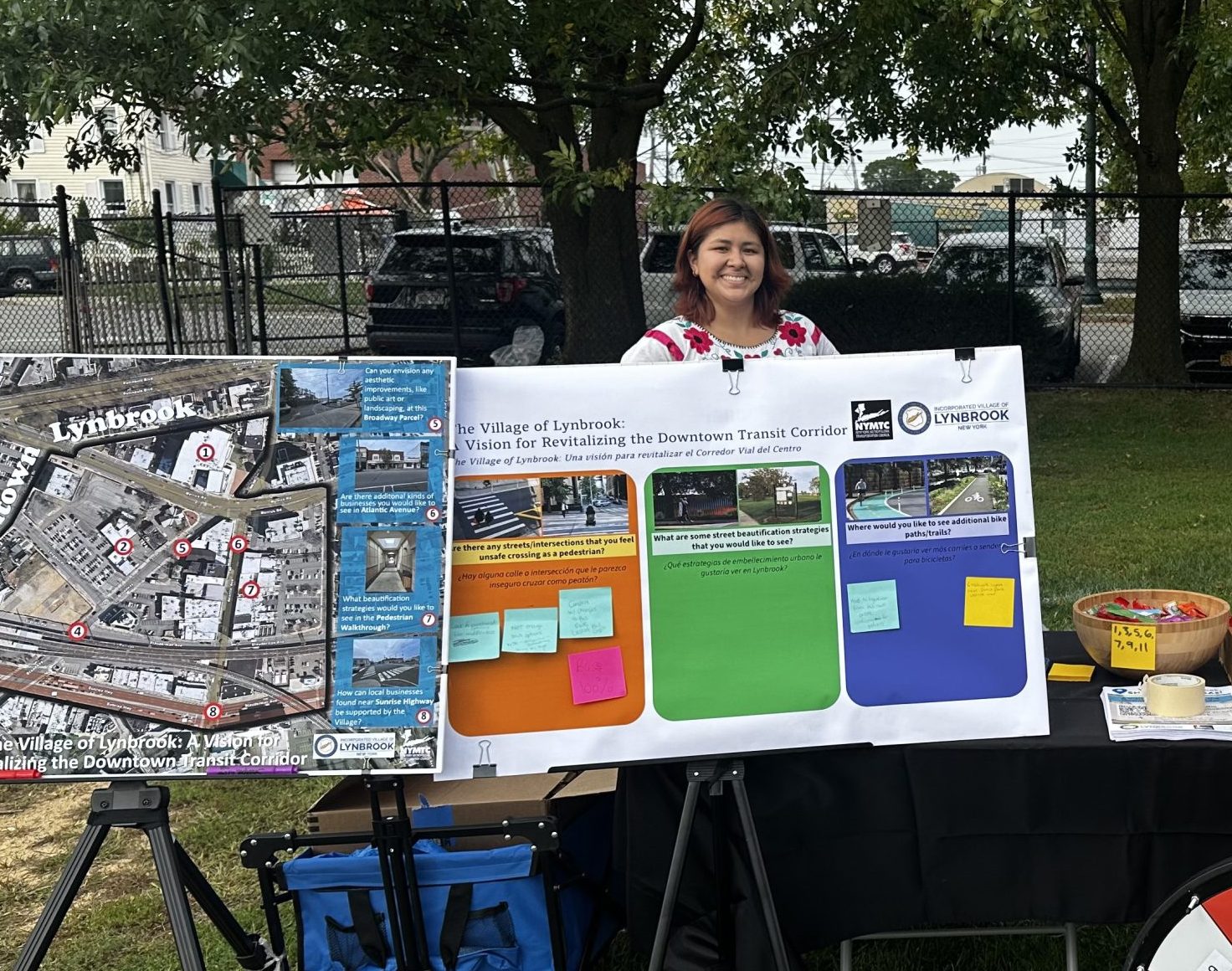
Kenia Gonzalez recently joined the Alan M. Voorhees Transportation Center as its Bilingual Outreach Specialist. We spoke with her about her role and why language access plays a critical part in VTC’s work.
Kenia leads Spanish-language translation, interpretation, public engagement, and community outreach across multiple VTC projects. Her work expands access to transportation planning by engaging Spanish-speaking communities, supporting meaningful participation, and ensuring residents stay informed and empowered to contribute to decisions that shape their environment. Through this work, she focuses on reducing language barriers and strengthening connections between planners and the diverse communities they work with.
Learn more about Kenia and her approach to bilingual outreach.
How did you become a bilingual outreach specialist?
I started as a bilingual research assistant, which focused more on the technical aspects of my role, such as translating projects and researching approaches to community engagement rather than conducting outreach directly. As I began working on more projects at VTC, I found myself drawn to the engagement side of the work—talking with people and having meaningful conversations, especially across languages.
During my first canvassing experience at VTC, I spoke with business owners, residents, and staff at local facilities about urban planning and what they felt their community needed. Through these conversations, my colleagues noticed my ability to connect with people easily and engage them in discussion. After that experience, my former supervisor shifted my focus to a bilingual outreach assistant role.
Since then, I’ve translated project materials and community surveys, canvassed across multiple projects, and engaged with both English- and Spanish-speaking community members. I encourage residents to share their perspectives on what their community needs and to offer their thoughts on urban planning as part of the community engagement process.
What have you learned since beginning translating in the urban planning and transportation field?
I’ve learned so much to begin with. I actually didn’t know about the urban planning world. It was probably a field that I kind of knew very vaguely, and not the technical aspect that it requires as I’ve seen applied in like most of these projects.
While I’ve been acquiring my translation skills, there’s so many things that are involved, not just being bilingual, but researching, trying to find the accurate meaning. I was learning two skills at the same time, which would be translating, but also diving into a field that I never thought I’d actually translate.
Why is translation important to the work at VTC?
The projects we’ve done at VTC have mostly been guided toward one language, which is obviously English, but there’s also a huge component of other languages in the communities we work with. When we do research and community engagement, it’s not just English-speaking residents—we [often] encounter people from different language backgrounds and cultures.
An important aspect is getting their input so we can apply that feedback in VTC projects. The more community input we have, the better. Translating materials into a language the community feels comfortable with is huge for them. It’s also a way to spread awareness about urban planning. As I mentioned before, I didn’t know what urban planning was, and I don’t think I’m the only one—most of the general public probably only has a vague idea of what it is.
How has your experience been conducting community outreach and engagement at VTC?
I’ve really enjoyed this work, not just in English, but in Spanish as well. I’ve done canvassing, community outreach, and worked on different projects, and all of them have been rewarding—especially in terms of connecting with people. Like I mentioned before, it’s about providing people with information about things that could improve their community and having those conversations where they explain what they need, share things we may not have considered, and talk about how they feel the project is going overall.
One particular experience I had, aside from working in Spanish, was engaging with people in French. French is my third language—I’m not a native speaker, of course, but I do have a certain level of proficiency. On this project, we had a few people who spoke French, and this really highlighted the need to advocate for more translations in different languages. We should be providing recommendations, community surveys, and graphics in multiple languages. These community members noticed that the survey was available in English and Spanish and asked why there wasn’t a French version as well.
That’s something we should consider—and something we have been considering at VTC—by including more languages so people can share their feedback, opinions, and thoughts about the project.
What progress would you like to see in bilingual outreach in transportation planning?
The progress that I would really like to see is that VTC can apply, at least in their projects, a language program. Not just a language program, but creating materials in different languages. I focus on Spanish, but there are many more languages where we could get feedback and different perspectives.
What I would really like to see is people from the Spanish-speaking community know about urban planning—what it is, the process it takes to develop a project, and the background behind it. I want people to be more informed about urban planning so they can have much more impactful participation when we do community outreach.
What is your personal goal as the Bilingual Outreach Specialist at VTC?
My goal is to reach out to communities that have implicitly been pushed away so they can provide their feedback and be informed about everything happening in their community. I want them to have the power to participate, which is something I advocate for through language—giving people the power to be involved and to stay informed.
Interview was edited for length and clarity