


On Monday, December 15, 2025, the New Jersey Target Zero Commission officially adopted the first New Jersey Target Zero Action Plan, reaching a major milestone in the Garden State’s goal to eliminate all roadway fatalities and serious injuries in the state by 2040. The Action Plan includes 72 actions, including the establishment of a Target Zero Rapid Response Program. This Action Plan marks a turning point in transportation safety work, almost a year after Governor Phil Murphy signed P.L. 2024, c.109 into law in January 2025, signifying the state’s commitment to eliminating traffic fatalities and serious injuries by 2040. The New Jersey Target Zero Action Plan is now publicly accessible via the New Jersey Department of Transportation’s Target Zero Webpage. Now, the work begins to translate the components of the plan into implementation.
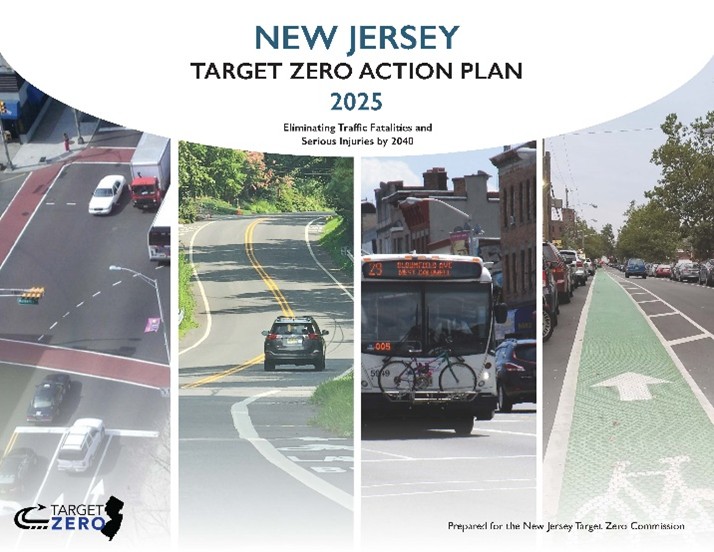
Caption: The New Jersey Target Zero Action Plan (2025)
The Target Zero Action Plan Process
Target Zero aligns with other leading transportation safety frameworks, such as Toward Zero Deaths, Vision Zero, Driving Towards Zero Deaths, and the Safe System Approach, in its commitment to reducing and ultimately eliminating roadway fatalities and serious injuries. At its core, Target Zero is grounded in the belief that traffic deaths and severe injuries are not an unavoidable cost of mobility, but unacceptable outcomes that can and must be prevented.
This law established the Target Zero Commission, which comprises representatives from 13 state and regional agencies and is chaired by the Commissioner of Transportation. The Alan M. Voorhees Transportation Center (VTC) at Rutgers University was selected to assist the Commission’s ambitious efforts to draft and adopt the comprehensive statewide action plan before the end of 2025.
To guide the development of the Action Plan, VTC formed a collaborative working group of Commission members, policymakers, engineers, planners, advocates, law enforcement, academic institutions, local leaders, subject matter experts, and members of the public. The Action Plan’s development required an eight-month-long process and six monthly meetings of research, collaboration, and public engagement. During these meetings, the Working Group reviewed existing best practices, developed and prioritized actionable recommendations, and informed the content and structure of the Target Zero Action Plan.
After refining these actions, VTC conducted prioritization exercises with the Working Group to evaluate each action and its associated recommendations, based on its potential impact, feasibility, and alignment with the state’s goal of eliminating traffic-related fatalities and serious injuries by 2040. This collaborative process strengthened the Action Plan and ensured it reflects the perspectives of both technical experts and the communities it is designed to protect. This process resulted in 72 Actions, 40 of which are non-legislative, and 32 that have legislative components.
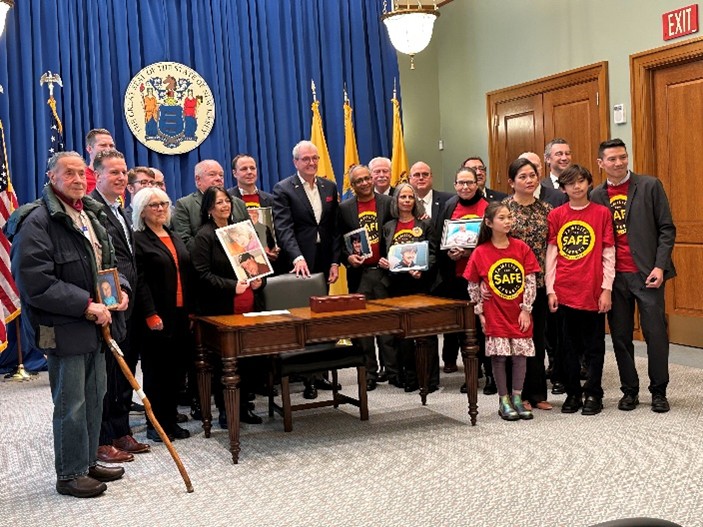
Caption: In January 2025, Governor Phil Murphy signed the Target Zero Commission Law establishing the New Jersey Target Zero Commission with the goal of eliminating traffic fatalities and serious injuries on New Jersey’s roads by 2040.
Target Zero Rapid Response Program
One of the non-legislative actions is a Target Zero Rapid Response Program. The action calls for lawmakers to “explore a model Target Zero Rapid Response Program for adoption by New Jersey municipalities, including incorporating crash investigator teams, with representation from law enforcement, fire, EMS, planning, and engineering, into the rapid response structure to support thorough on-site reviews of fatal and serious injury crashes.” This action was developed early in the Action Plan process and was identified as having both a high impact and a shorter time frame for a pilot program.
The Target Zero Rapid Response Program treats fatal crashes as public emergencies requiring quicker, coordinated action. It offers a proactive framework for addressing roadway safety challenges by deploying immediate countermeasures, such as enhanced signage and pavement markings, temporary cones and bollards to reduce speeds, and adjustments to signal timing and phasing.
A key principle of a Rapid Response Program is to establish a process that triggers immediate actions to review and mitigate the root causes of fatal and serious injury crashes. The program relies on a multidisciplinary team that conducts holistic crash reviews and recommends safety improvements.
Rapid Response Programs in U.S. Cities
Rapid Response Programs have taken various forms: some launch pilot demonstrations within 48 hours, while others deliver improvements in under a year. To date, these efforts have been localized, primarily in urban settings; no statewide rapid response program currently exists in the United States. For instance, Vision Zero cities like New York and San Francisco have piloted crash investigator or fatality review teams that bring together police, engineers, and public health staff.
Several New Jersey cities have also implemented similar programs. Hoboken has deployed emergency street responses in its Vision Zero work, including temporary traffic calming near crash sites and quick-build pedestrian safety improvements. Jersey City has also piloted similar “pop-up” fixes, such as curb extensions and protected bike lane treatments, after serious crashes occur.
The City of Denver, Colorado, created a comprehensive Rapid Response Program embedded within its Vision Zero Action Plan in 2017. Denver’s Rapid Response team, made up of four engineers and planners, reviews historic crash data to identify patterns and convenes after pedestrian, motorcyclist, and bicyclist fatalities to implement short-term treatments. The Rapid Response program also fosters collaborations across city and state agencies like the Denver Police Department, Colorado State Traffic Records Advisory Committee, and the Colorado Department of Revenue to use crash trends and rapid response information to identify locations for street modifications.
Since 2020, Denver’s Rapid Response team has recommended over 50 signage, pavement markings, and/or signal timing changes, and has suggested education and enforcement improvements through marketing campaigns or targeted enforcement efforts. At one specific intersection in Denver, the Rapid Response team’s recommendation of improved signage and increased enforcement reduced crashes by 33%.
Conclusion
The adoption of the New Jersey Target Zero Action Plan marks a pivotal step in the journey to zero fatal and serious injury crashes by 2040. Within the plan’s comprehensive framework, the Target Zero Rapid Response Program stands out as an innovative tool for bringing action to New Jersey’s vision. The program aims to treat fatal and serious injury crashes as instances within a broader public health emergency so that the underlying causes of crashes are examined and addressed. A coordinated, multidisciplinary response can help more quickly apply evidence-based solutions where they are needed most. Establishing a statewide model and framework will help ensure that lessons learned in one community can inform best practices throughout the state.
As New Jersey moves from planning to implementation, the Rapid Response Program represents an opportunity to translate the Action Plan’s goals into immediate, measurable changes. This aggressive approach can not only save lives and strengthen interagency partnerships but also build public trust, awareness, and engagement in transportation safety efforts.
This article originally appeared on the New Jersey State Policy Lab website.