


A study was done to estimate price, income, vehicle stock, metro fares, and fuel-efficiency elasticities of the demand for road traffic in Mexico City, Mexico.
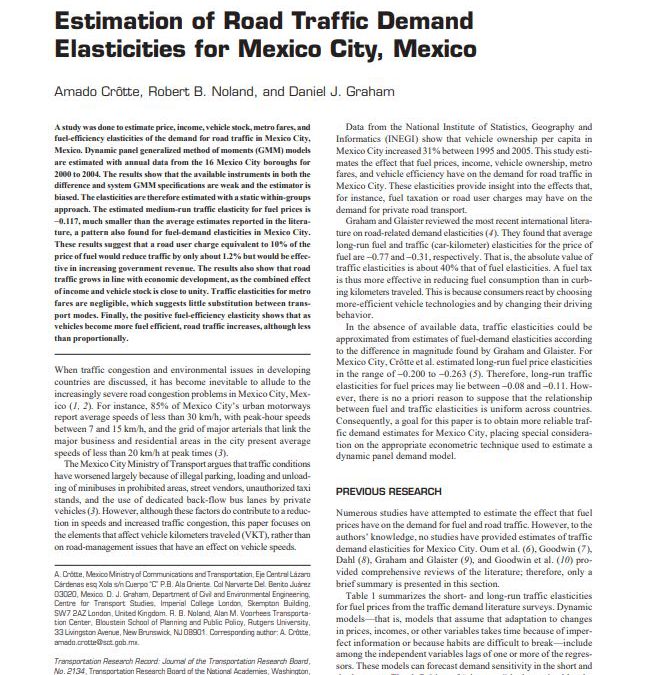
A study was done to estimate price, income, vehicle stock, metro fares, and fuel-efficiency elasticities of the demand for road traffic in Mexico City, Mexico.
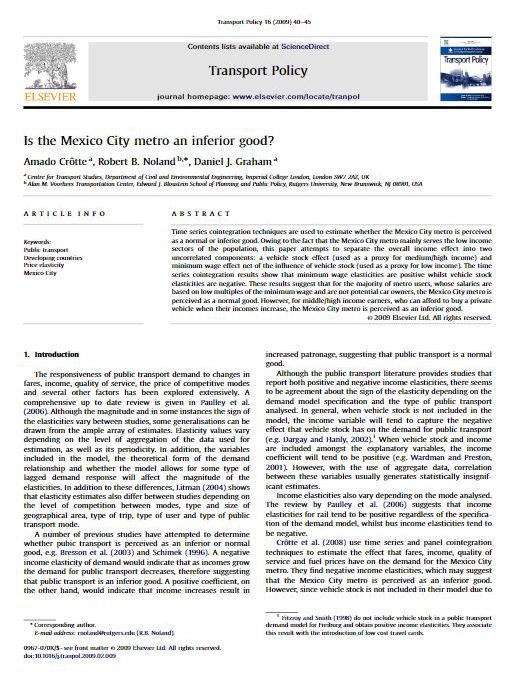
This paper attempts to separate the overall income effect into two uncorrelated components: a vehicle stock effect (used as a proxy for medium/high income) and minimum wage effect net of the influence of vehicle stock (used as a proxy for low income).
Transportation researchers rarely publish findings from qualitative methods in peer-reviewed transportation journals; quantitative methods dominate research in the field. In this article, we document the paucity of qualitative research in transportation journals and...
Virtual public involvement (VPI), defined by the Federal Highway Administration as “the use of digital technology to engage individuals or to visualize projects or plans,” is now an essential part of public participation in transportation planning and project...
We report on an analysis of carbon emissions from commuting to a large multi-campus university system, Rutgers, the State University of New Jersey. This is derived from a campus survey to assess carbon emissions and various attitudes towards sustainability across a...
Women and sexual and gender minorities (SGMs) have unique transportation experiences and needs, including public transit services. However, there is a gap in the data that documents their experiences and needs. This paper aims to add to existing research by examining...