


In an effort to understand how changes in mobility are associated with the spread of the coronavirus, mobility data from Google correlated with estimates of the effective reproduction rate, a measure of viral infectiousness.
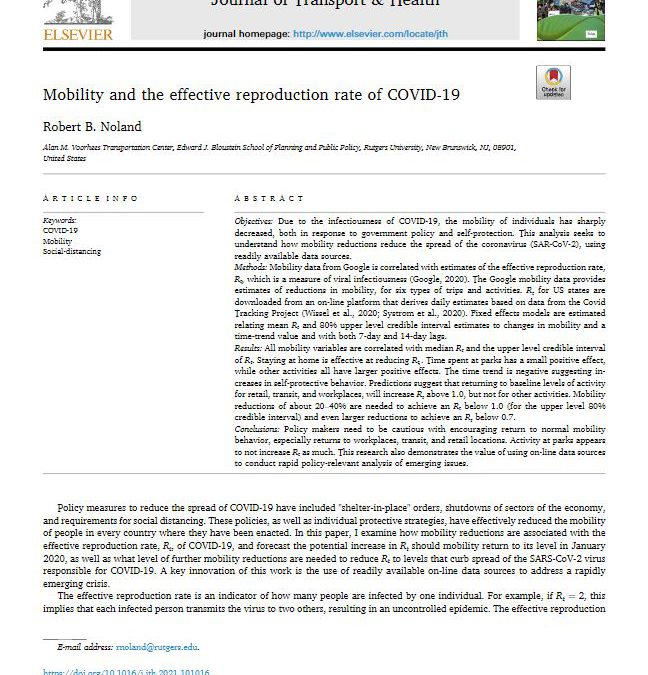
In an effort to understand how changes in mobility are associated with the spread of the coronavirus, mobility data from Google correlated with estimates of the effective reproduction rate, a measure of viral infectiousness.

Bikeshare use in New York City dropped substantially during the initial months of the COVID-19 pandemic, but by summer of 2020 had largely recovered to pre-pandemic levels. The patterns of usage, however, have changed.
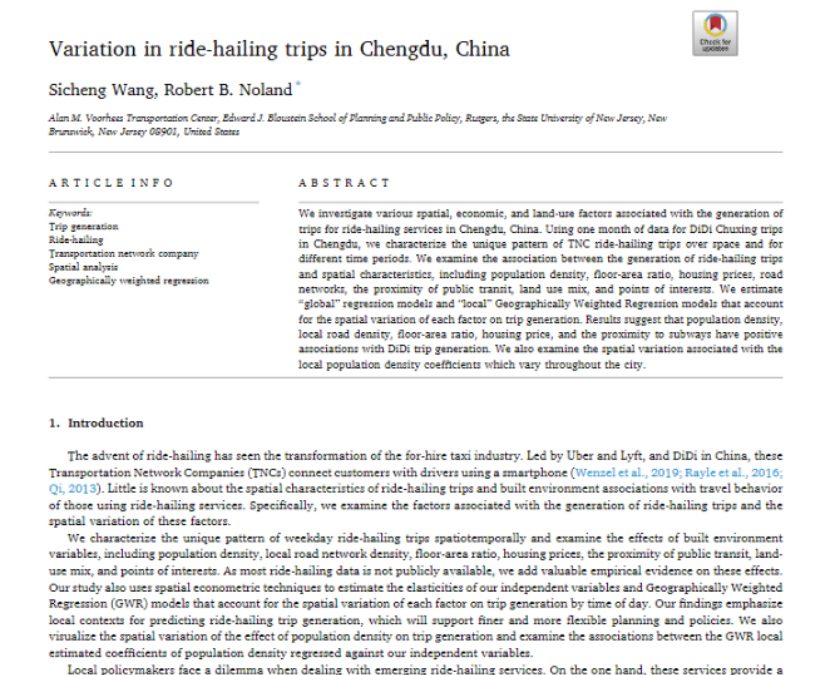
A new paper looks at the elasticities of demand for ride-hailing service provider DiDi in Chengdu, China.

Data on shared e-scooters in Louisville, Kentucky are analyzed.
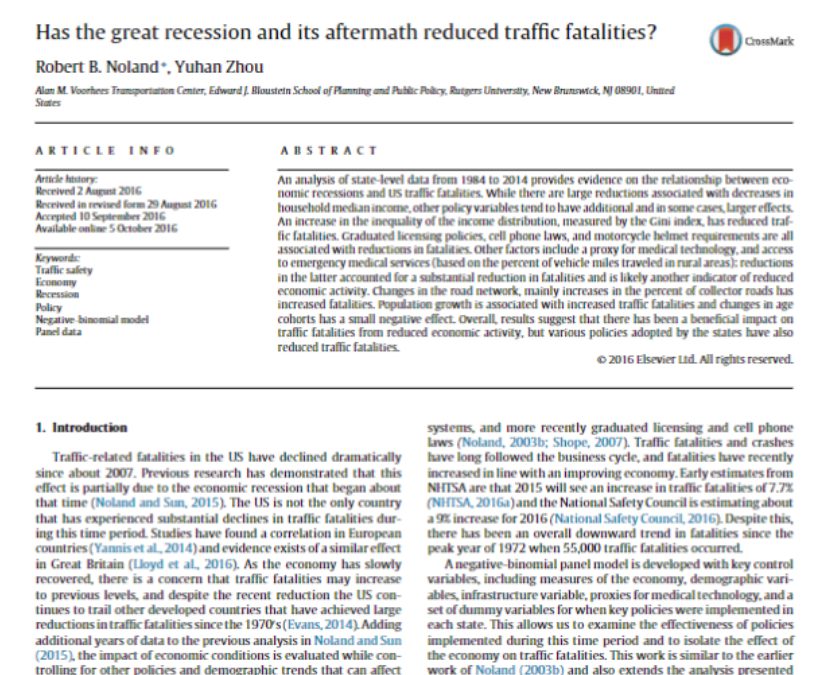
An analysis of state-level data from 1984 to 2014 provides evidence on the relationship between economic recessions and US traffic fatalities.
A response to the six points made by Le Vine and conclude with a brief critique of existing practice.
We evaluated a training course called “Orientation to Transit Procurement”, designed and conducted by the National Transit Institute.
The question addressed here is how, if at all, TOD and TOD-proximate residents’ perceptions of the benefits and shortcomings of TOD are perceived and addressed by professionals involved with TOD planning and development.
This study provides an overview of the beneficial impacts of transit-oriented development – compact, mixed-use pedestrian land uses within walking distance of transit stations.
The analysis presented here examines the frequency of using these modes of travel for those living in TODs and proximate to a train station versus those living more distantly.
Recent advances in biometric sensing technologies, such as eye tracking, heart rate trackers, and galvanic skin response (GSR) sensors, offer new opportunities to measure pedestrian stress level and their travel experiences in real-time. Uncertainty remains about...
Background Increasing evidence positively links greenspace and physical activity (PA). However, most studies use measures of greenspace, such as satellite-based vegetation indices around the residence, which fail to capture ground-level views and day-to-day dynamic...
Induced travel elasticities associated with new road capacity are typically estimated for roads of higher functional classifications, such as interstate freeways and principal arterials. These are estimated as “own” elasticities, that is an increase in lane kilometers...
There is a growing perception that e-scooters are more dangerous than bicycles and e-bikes, with towns implementing measures to ban their usage. Yet, there is not much evidence from large scale surveys to substantiate this claim. Nearly 14,000 micromobility injuries...