


The review commends the editors and chapter authors for emphasizing the importance of equity in bicycle planning and discusses the difficulties in implementing equity in transportation planning generally.
The review commends the editors and chapter authors for emphasizing the importance of equity in bicycle planning and discusses the difficulties in implementing equity in transportation planning generally.
With the conjecture that mobility is affected by both personal impairments and automobile access, this paper examined how difficulty walking, difficulty climbing stairs, and automobile ownership affect subjective wellbeing.
Using data from the 2009 National Household Travel Survey (NHTS), this paper examines the potential impacts of nationally standardizing school start time at 8:30 AM with a focus on household members who give children rides to/from school and their travel patterns before and after escorting children.
The study sets benchmarks for current population characteristics of the areas near commuter rail stations in New Jersey and compares changes of the characteristics between 1990 and 2013 by using the Geolytics Neighborhood Change Database.
Issues that relate to distracted driving and walking are discussed by presenting results from a survey of planning professionals, police officers, and pedestrians in New Jersey.
To bridge the existing information gap, this paper provides results from a recent survey that focused exclusively on adults with ASD in New Jersey to learn about their travel patterns, the importance of the various types of trips they make, and the barriers they encounter regarding the use of different transportation modes.
This study estimated the impact of spending by North Jersey Coast Line (NJCL) riders during summer weekends on the economies of the Jersey Shore communities known for beach-oriented recreational activities.
With the use of U.S. Consumer Expenditure Survey data, this study made an effort to bridge the gap in the existing knowledge base through an examination of the relationship between household expenditures on housing and overall transportation.
Explores and documents transportation needs and barriers of NJ adults on the Autism spectrum.
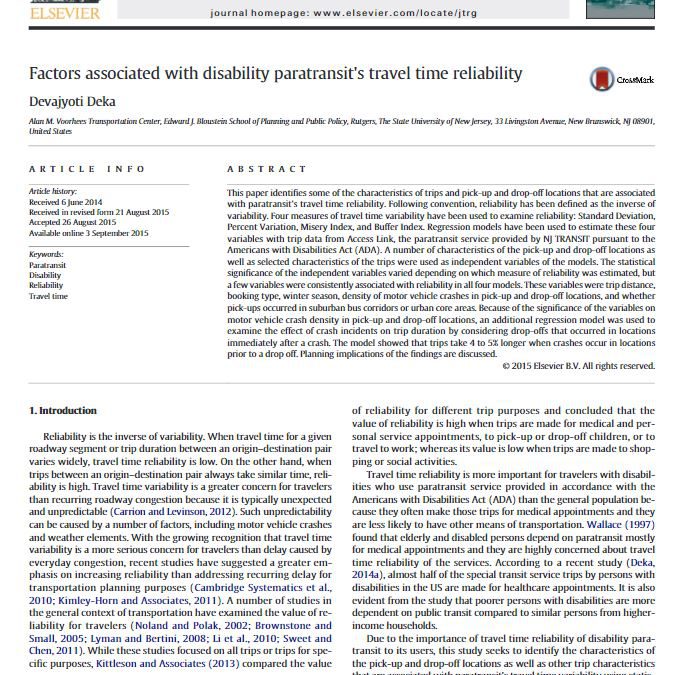
This paper identifies some of the characteristics of trips and pick-up and drop-off locations that are associated with paratransit’s travel time reliability.
Since its creation in 1979, NJ TRANSIT has grown into the geographically largest public transit system in the United States. Over more than four decades, the agency’s financial structure has shifted in response to changing state and federal priorities—shaping service...
Harassment, discrimination, and violence are major concerns for women and sexual and gender minorities (SGMs) who ride public transit. However, these experiences often go underreported, and agencies may not be aware of the extent of harassment within their services....
Objective While fatal crashes are available through the Fatality Analysis Reporting System (FARS) and are readily available to the public, many states do not make their crash data easily accessible for the public and the research community. The public has an interest...
Through this research, NJ TRANSIT sought to understand how women and members of the lesbian, gay, bisexual, transgender, queer plus community, sometimes referred to as sexual and gender minorities (SGMs) travel on NJ TRANSIT so the agency can provide better...